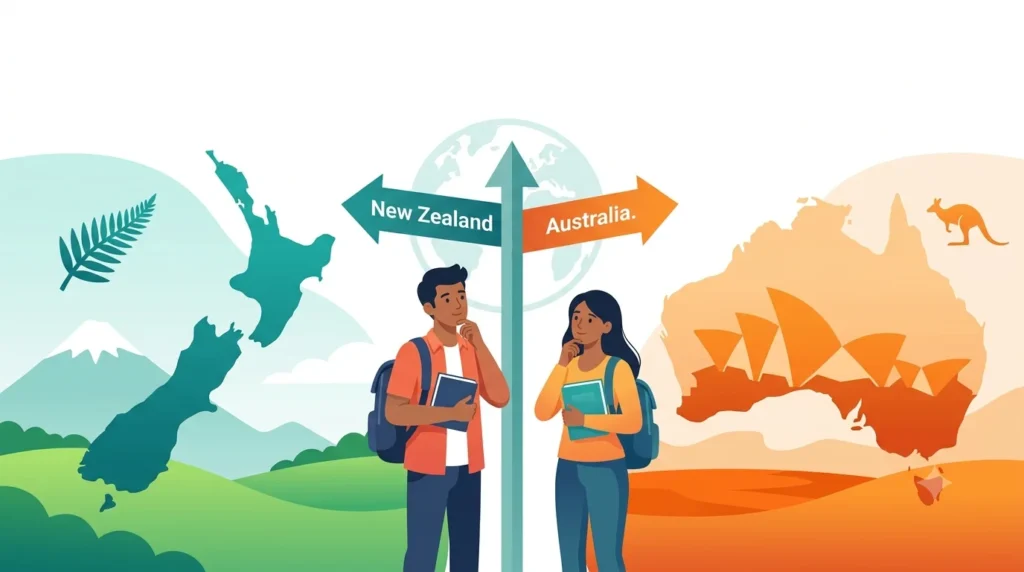
Every year, thousands of Bangladeshi students sit down with the same two brochures on the table: one for Australia, one for New Zealand. Both countries speak English. Both have world-ranked universities. Both promise a path to permanent residency after graduation. And both, understandably, leave students more confused after the research than before it.
If you’re trying to decide between studying in New Zealand vs Australia for Bangladeshi Students, the honest answer is: it depends on your budget, your career goals, and how much competition you’re willing to face after graduation. This guide breaks down the real numbers — tuition fees, visa costs, work rights, post-study visas, and living expenses — so you can make the decision with facts, not guesswork.
Quick Comparison: New Zealand vs Australia for Bangladeshi students at a Glance
| Factor | New Zealand | Australia |
|---|---|---|
| Average annual tuition (Bachelor’s) | NZD 31,000 – 58,000 | AUD 30,000 – 45,000 |
| Student visa application fee | Around NZD 750 | AUD 2,500 (from July 2026) |
| Proof of funds (living costs/year) | NZD 20,000 | AUD 29,710 |
| Part-time work hours (term time) | Up to 25 hours/week | Up to 48 hours/fortnight (~24/week) |
| Post-study work visa | Up to 3 years | 18 months to 6 years (Subclass 485) |
| Visa processing time | 5–8 weeks | 4–8 weeks (varies by institution) |
| Popular cities for Bangladeshi students | Auckland, Wellington, Christchurch | Sydney, Melbourne, Brisbane, Adelaide |
| Bangladeshi community size | Smaller, growing | Large and well-established |
Now let’s unpack each of these points, because the numbers alone don’t tell the full story.
1. Tuition Fees: Which Country Is Cheaper to Study In?
For most Bangladeshi families, cost is the deciding factor before anything else, so it’s worth comparing this closely.
Studying in New Zealand generally costs between NZD 31,000 and 58,000 a year for a bachelor’s degree, and NZD 35,500 to 58,000+ for a master’s, depending on the university and subject. Business and arts programmes sit at the lower end, while engineering, health sciences, and specialised master’s degrees can push past NZD 65,000 a year. On top of tuition, universities charge a Student Services Levy, typically around NZD 1,100 a year, which covers campus facilities and student support.
One detail that often gets missed: international PhD candidates who live in New Zealand during their doctorate pay domestic-equivalent fees under a government scheme. This makes a New Zealand PhD one of the most affordable postgraduate research options in the English-speaking world.
Studying in Australia usually costs AUD 30,000 to 45,000 a year for undergraduate programmes and AUD 35,000 to 50,000 for postgraduate degrees, with professional courses like medicine and veterinary science costing significantly more.
On paper, tuition costs in both countries are broadly comparable once you convert currencies, though New Zealand institutions outside the largest cities (such as Waikato, Massey, or Lincoln) tend to offer slightly lower fees than Australia’s top-tier universities in Sydney or Melbourne. If your budget is tight, it’s worth comparing specific universities and cities rather than the country as a whole, since the fee range within each country is wide.
2. Student Visa Cost and Requirements
This is one area where the gap between New Zealand vs Australia for Bangladeshi Students has become significant .
New Zealand’s Fee Paying Student Visa costs around NZD 750 to apply. You’ll need to show tuition fees are paid (or payable) plus living funds of NZD 20,000 per year, in addition to a return airfare. Processing typically takes five to eight weeks, and the country accepts online applications only.
Australia’s Subclass 500 Student Visa now costs AUD 2,500 for the primary applicant, following a fee increase in July 2026 — more than triple what New Zealand charges. You must also prove access to at least AUD 29,710 per year in living costs, plus tuition and travel expenses, and satisfy the “Genuine Student” requirement, which replaced the older Genuine Temporary Entrant test in 2024. Processing times vary widely depending on your chosen institution’s compliance record, with some approved institutions seeing decisions in as little as a week, and others facing months of delay.
For Bangladeshi applicants specifically, both countries require standard documentation: academic transcripts, English test scores (IELTS, PTE, or equivalent), bank statements or education loan letters, and in some cases a medical exam and police clearance certificate. Neither country accepts a sudden large deposit into your bank account just before applying — both immigration departments flag this as a red risk indicator, so your financial history needs to look consistent over time.
3. Work Rights While Studying
Both countries let international students work part-time, but the details differ slightly.
- New Zealand: Up to 25 hours per week during term time (increased from 20 hours in late 2025), and full-time during scheduled holidays. Master’s by research and PhD students can work unlimited hours.
- Australia: Up to 48 hours per fortnight during term (roughly 24 hours a week), and unlimited hours during official course breaks. The same unlimited allowance applies to Master’s by Research and PhD students once their research has commenced.
In practice, this means New Zealand currently offers a slightly higher weekly work allowance for standard degree students, which can help offset living costs a little more than Australia’s fortnightly cap.
4. Post-Study Work Visa and Pathway to PR
This is often the single biggest factor in the New Zealand vs Australia decision, because it determines whether your degree can eventually lead to permanent residency.
New Zealand’s Post-Study Work Visa allows eligible graduates to stay and work for up to three years, and the 2026 Green List has opened streamlined residence pathways for graduates in high-demand fields such as engineering, health, and IT. Because New Zealand’s population and job market are smaller, competition for skilled roles can be less intense, but the total number of job openings is also naturally lower than in Australia.
Australia’s Temporary Graduate Visa (Subclass 485) grants between 18 months and 6 years of post-study work rights depending on your qualification level and location of study (regional campuses often earn longer stays). However, the 485 visa fee rose sharply in 2026 — first doubling to AUD 4,600 in March, then rising again to AUD 5,750 from July — and eligibility now requires applicants to be under 35 with a stronger English score (IELTS 6.5). From there, graduates can pursue permanent residency through skilled visas such as Subclass 189, 190, or 491.
Both pathways are real, but Australia’s system currently comes with a heavier upfront cost, while New Zealand’s is cheaper to enter but offers fewer total job openings simply due to market size. If your goal is long-term migration, look closely at whether your specific course and occupation appear on each country’s skilled/Green list before you commit.
5. Cost of Living: New Zealand vs Australia for Bangladeshi students
Living costs matter just as much as tuition, especially over a two- to four-year programme.
New Zealand requires proof of at least NZD 20,000 per year for living expenses, while Australia’s requirement sits at AUD 29,710 per year — noticeably higher on paper. In real terms, rent in Auckland and Wellington is generally more affordable than in Sydney or Melbourne, though smaller Australian cities like Adelaide and Brisbane can be comparable to or cheaper than New Zealand’s main cities. Grocery, transport, and utility costs are broadly similar between the two countries, with Australia’s larger cities usually running slightly higher due to demand from a much bigger international student population.
If affordability outside tuition is your main concern, New Zealand’s smaller cities and Australia’s regional campuses (which sometimes come with added visa or PR benefits) are both worth comparing directly against Sydney or Auckland before assuming one country is cheaper overall.
6. Quality of Education and University Rankings
Australia has a larger number of globally ranked universities — institutions like the University of Melbourne, University of Sydney, ANU, and UNSW consistently appear in the world’s top 100, giving Australia stronger global brand recognition, particularly useful if you plan to work internationally after graduation.
New Zealand’s eight public universities, including the University of Auckland and University of Otago, are all internationally recognised and generally rank respectably in global tables, though New Zealand doesn’t have as many institutions in the very top tier. What New Zealand does offer is smaller class sizes and a closer-knit academic environment, which some students prefer over the scale of Australia’s larger campuses.
For highly competitive fields like medicine, engineering research, or business at the postgraduate level, Australia’s broader range of specialised and top-ranked programmes may give you more choice. For students prioritising a calmer environment, more personalised support, and slightly lower entry competition, New Zealand can be the better fit.
7. Bangladeshi Student Community and Support
Australia has a long-established Bangladeshi community, particularly in Sydney and Melbourne, with community associations, Bangla grocery stores, restaurants, and cultural events that make settling in easier — especially in your first few months.
New Zealand’s Bangladeshi community is smaller but steadily growing, concentrated mainly in Auckland. You may find it takes a little longer to find familiar food, community support, or a Bangla-speaking network, though university international student offices in both countries provide solid orientation and settling-in support regardless of community size.
8. Climate, Safety, and Lifestyle
Both countries rank consistently among the safest in the world for international students. Australia’s climate varies enormously by city — Brisbane is warm year-round, while Melbourne has four distinct seasons. New Zealand has a cooler, more temperate climate overall, with more visible mountains, coastlines, and outdoor lifestyle culture packed into a smaller geography.
Neither factor should be a dealbreaker on its own, but if you know you struggle with cold weather or prefer access to warmer city options, this is worth weighing alongside the financial and academic factors above.
So, Which One Is Actually Better for You?
There’s no single right answer — it depends on your priorities:
- Choose Australia if: you want access to top-100 global universities, a large and established Bangladeshi community, more job openings after graduation, and you’re comfortable with a higher upfront visa cost.
- Choose New Zealand if: you want a lower visa application fee, slightly more weekly work hours as a student, a calmer study environment, and you’re pursuing a PhD (where NZ’s domestic-fee policy is a major cost advantage).
For many Bangladeshi students, the decision ultimately comes down to which university offers you an admission and scholarship that fits your budget — and that’s exactly where expert guidance becomes valuable, because course-by-course and city-by-city costs vary far more than the national averages suggest.
How PEC Education Consultants Helps Bangladeshi Students Choose the Right Country
Comparing New Zealand and Australia on paper is one thing — figuring out which specific university, course, and visa pathway is right for your academic background, budget, and career goals is another. This is where PEC Education Consultants comes in.
Based in Dhaka since 2016, PEC Education Consultants has guided Bangladeshi students toward study destinations in the USA, UK, Canada, and Australia, offering free, one-on-one consultancy at every stage of the journey. Here’s how PEC supports students weighing options like New Zealand and Australia:
- Free personalised counselling: PEC’s consultants assess your academic profile, budget, and career goals before recommending a country and university — rather than pushing a one-size-fits-all destination.
- University and course matching: With an established network of partner institutions, PEC helps shortlist universities and programmes that genuinely match your grades, subject interest, and financial capacity.
- English test preparation: PEC runs its own dedicated test preparation centre for PTE Academic and TOEFL, helping students meet the English proficiency scores required for admission and visa approval.
- End-to-end visa support: From compiling financial documents to preparing for visa interviews, PEC’s team guides students through the entire student visa application process, reducing the risk of avoidable rejections.
- No hidden charges: PEC’s consultancy is completely free for students, with full transparency on which costs (tuition, embassy fees, medical checks) are paid directly to the relevant institution or government body.
- Two convenient locations: With centres in Mirpur-10 and Uttara, Dhaka, PEC offers in-person consultations six days a week for students who prefer face-to-face guidance over the phone.
Whether you’re leaning toward Australia’s globally ranked universities or New Zealand’s more affordable visa and calmer campus life, a good consultant helps you see past the marketing and into the real cost-benefit picture for your specific situation.
Frequently Asked Questions
Is it cheaper to study in New Zealand vs Australia for Bangladeshi Students? Tuition fees are broadly comparable between the two countries once converted to a common currency, but New Zealand’s student visa application fee (around NZD 750) is significantly lower than Australia’s (AUD 2,500 from July 2026), making New Zealand’s upfront visa cost cheaper.
Which country offers a better post-study work visa? Australia’s Subclass 485 visa can offer up to 6 years of post-study work rights depending on qualification and study location, longer than New Zealand’s standard 3-year post-study work visa — but Australia’s 485 visa fee has risen sharply in 2026, so the total cost-benefit depends on your field and career plans.
Can Bangladeshi students work while studying in New Zealand or Australia? Yes. New Zealand allows up to 25 hours per week during term time, while Australia allows up to 48 hours per fortnight (about 24 hours per week). Both allow unlimited hours during official holiday periods.
Which country has more Bangladeshi students? Australia has a considerably larger and more established Bangladeshi student community, particularly in Sydney and Melbourne, compared to New Zealand’s smaller but growing community, mainly in Auckland.
Do I need an education consultant to apply for New Zealand or Australia? It’s not mandatory, but a consultant like PEC Education Consultants can help you choose the right university and course, prepare a stronger visa application, and avoid common documentation errors that lead to delays or rejections — all at no cost to the student.
Final Thoughts
Both New Zealand and Australia offer genuine, high-quality pathways for Bangladeshi students — the “better” choice depends entirely on your budget, target career, and how much value you place on post-study work duration versus lower upfront visa costs. Rather than choosing a country based on general reputation alone, compare specific universities, courses, and total costs side by side.
If you’d like personalised guidance on which country, university, and course fits your profile, PEC Education Consultants offers free consultations at their Mirpur-10 and Uttara centres in Dhaka — a good next step before you finalise your study abroad decision.
Disclaimer: Visa fees, financial requirements, and immigration policies for New Zealand and Australia change periodically. Always confirm current figures with Immigration New Zealand (immigration.govt.nz) and the Australian Department of Home Affairs (immi.homeaffairs.gov.au), or consult with PEC Education Consultants, before making your final decision.