Dreaming of a U.S. Degree? What Every Bangladeshi Student Should Know Before Applying
Updated November 2026 | Reading time: about 18 minutes | Published by PEC Education Consultants
If you have ever imagined walking across an American campus with a book in one hand and a big future ahead of you, you are not alone. Every year, thousands of young people in Bangladesh dream of earning a U.S. degree, and many of them turn that dream into a career and a life-changing experience. The goal is real and reachable. But the road to study in USA from Bangladesh is also long, detailed and, in recent years, more demanding than before.
The United States has thousands of colleges and universities, each with its own deadlines, tests, costs and scholarship rules. On top of that, the USA student visa for Bangladeshi students has become a process that needs careful preparation, honest documents and clear answers. A small mistake at any stage can delay your plans or close a door you worked hard to open.
This guide explains everything you need to know before you start. You will learn how to apply to US universities from Bangladesh, what the US university admission requirements Bangladesh applicants face, how scholarships for Bangladeshi students in USA work, what the F-1 visa Bangladesh process looks like, and how study abroad consultants in Bangladesh, especially PEC Education Consultants, can guide you from your first question to your first day on campus.
Want personal advice right away? Visit PEC’s dedicated Study in USA page, browse all Study Destinations, or book a free appointment with our counselors.
Why Do So Many Students Choose to Study in USA from Bangladesh?

There are strong reasons why so many Bangladeshi students keep choosing the USA over other destinations.
Academic freedom and variety. American universities let you explore subjects before you commit. Many undergraduate programs allow you to change your major, combine fields and build a degree around your interests.
World-class research and technology. If you want to study in the USA in fields like computer science, engineering, data science, public health, business analytics or biotechnology, you will find well-equipped labs, research projects and industry connections.
Funding opportunities. Many universities offer merit scholarships, tuition waivers and assistantships. This is why scholarships for Bangladeshi students in the USA are one of the most searched topics among families planning higher education.
Global recognition. A degree from an accredited U.S. institution is respected by employers and universities around the world, including in Bangladesh.
Support for international students. Most campuses have international student offices, career centers, writing support and active communities of Bangladeshi students who can help you settle in.
Still, the decision to study in the USA should come from your academic goals, your family’s budget and your readiness for a new country, not from pressure or trends.
Popular fields among Bangladeshi applicants include Computer Science & IT, Business Management, Engineering and Health, Medicine & Life Science. You can read more about each of these programs on the PEC website.
Understanding the U.S. Education System Before You Apply
Before you pick a school, learn how the system works. This will make every other decision easier.
Undergraduate (bachelor’s) programs usually take four years. They are open to students who have finished HSC, A-Levels or an equivalent qualification. Applicants normally submit transcripts, English test scores, a personal essay, recommendation letters and sometimes SAT or ACT results.
Graduate (master’s) programs usually take one to two years. You need a completed bachelor’s degree, a statement of purpose, recommendation letters, a resume and, in some cases, GRE or GMAT scores.
Doctoral (PhD) programs often take four to six years and are research focused. Many are funded, but they are highly competitive.
Community colleges offer two-year associate degrees and transfer pathways to four-year universities. For some Bangladeshi students on a smaller budget, this can be a useful starting point, but transfer rules must be checked early.
Whatever level you choose, make sure the university is accredited and SEVP-certified, which means it is approved to enroll international students. Without this approval, you cannot receive the I-20 form you need for your F-1 visa.
US University Admission Requirements Bangladesh Students Must Meet
Requirements differ from one school to another, but most applicants meet a similar checklist. Understanding the US university admission requirements Bangladesh students usually face will help you plan your time and avoid last-minute stress.
1. Academic records. Undergraduate applicants submit SSC and HSC results or A-Level and O-Level results. Graduate applicants submit bachelor’s transcripts and certificates. Some universities ask for a credential evaluation from a service such as WES or ECE.
2. English proficiency. IELTS, TOEFL and Duolingo English Test scores are widely accepted. Minimum scores vary, so always read each program’s page carefully.
3. Standardized tests. Some undergraduate programs ask for the SAT or ACT, and some graduate programs ask for the GRE or GMAT. Many schools are now test-optional, but a strong score can still help your chances for admission and scholarships.
4. Statement of purpose or personal essay. This is where admissions officers learn who you are. A generic or copied essay will not help you. A personal, honest and specific story will.
5. Letters of recommendation. Most schools ask for two or three letters from teachers or professors who know your work well.
6. Resume or activities list. Include projects, internships, competitions, volunteering, leadership roles and research experience.
7. Proof of finances. Before issuing your I-20 form, the university needs evidence that you can pay for your first year.
Keeping all of these documents in one organized folder saves you weeks of work later.
Need help with your English test score? PEC runs its own English Test Preparation center with experienced trainers.
How to Apply to US Universities from Bangladesh: Step by Step
Here is a clear path for anyone who wants to apply to US universities from Bangladesh without getting lost.
- Start early. Begin 12 to 18 months before your intended start date. Deadlines for fall intake often fall between late autumn and early spring.
- Define your goals. Decide your field, level of study, budget and preferred location.
- Research and shortlist. Choose a balanced list of ambitious, realistic and safer universities. Six well-chosen schools usually work better than fifteen random ones.
- Prepare your tests. Register for English and other required exams early so you have time to retake them if needed.
- Write strong essays. Draft, revise and ask for honest feedback.
- Request recommendation letters. Give your referees plenty of time and a short summary of your achievements.
- Submit your applications. Use the university’s portal or a common application platform where available, and keep confirmation emails.
- Apply for scholarships. Many funding deadlines are earlier than admission deadlines, so check each school’s financial aid page.
- Compare offers. Look at total cost, funding, program quality and career outcomes.
- Accept and receive your I-20. Once you confirm your seat and show financial proof, the university issues the form you need for your student visa.
This is the core process, and it is also where expert advice from a study abroad consultant can save you time and prevent costly errors.
To see how PEC handles this step for students, read about our Overseas University Admission service and explore our Partner Universities Abroad.
What Does It Really Cost to Study in USA from Bangladesh?
Be realistic about money from day one. The total cost depends on your university type, city and lifestyle.
- Tuition: Public universities are often cheaper than private ones, but international students usually pay a higher rate than local residents.
- Living costs: Rent, food, transport, utilities and personal expenses vary greatly between a small college town and a major city.
- Health insurance: Most universities require international students to carry a health plan.
- Books, supplies and travel: These add up, especially in your first semester.
- Visa-related fees: Budget for the SEVIS fee, the visa application fee and, depending on current embassy practice, the new Visa Integrity Fee (see the visa section below).
Ask every university for its official estimated cost of attendance for international students. The I-20 form is based on this figure, and it is the amount you must show funding for when you apply for your visa.
Remember that working rights on an F-1 visa are limited. Part-time on-campus work can help with small expenses, but it should never be your main funding plan. A clear budget is one of the strongest foundations for anyone planning to study in the USA.
Scholarships for Bangladeshi Students in USA: What Is Available?

Funding is the number one concern for families, so let us look at the main types of scholarships for Bangladeshi students in USA.
University merit scholarships. Many schools reduce tuition for strong international applicants, sometimes automatically and sometimes through a separate application.
Need-based aid. This is limited for international undergraduates and offered mainly by a small group of well-funded universities.
Assistantships for graduate students. Teaching and research assistantships often include a tuition waiver and a monthly stipend. For many master’s and PhD applicants, this is the most realistic route among all funding options.
Fellowships and external awards. Some are linked to foundations, governments, professional bodies or specific fields of study. Availability changes every year, so always check official sources.
Departmental awards. Individual departments sometimes keep their own funding for talented students.
How to Improve Your Chances of Winning Scholarships
- Apply early. Funding often runs out on a rolling basis.
- Build a strong academic profile. Grades, test scores and projects matter.
- Tell a clear story. A focused essay beats a long, generic one.
- Contact professors politely. This is especially useful for research-based funding.
- Tailor every application. Never send the same essay to every school.
- Avoid false promises. No honest advisor can guarantee a scholarship. Be careful with anyone who does.
With the right plan, scholarships can make it much easier to study in the USA without putting unbearable pressure on your family.
For a detailed list of funding options, read PEC’s guide to the 15 Best Scholarships in USA and visit the main Scholarships & Waivers page.
USA Student Visa for Bangladeshi Students: The F-1 Process Explained

After you receive an admission offer and accept it, the next big step is the USA student visa for Bangladeshi students. Most students apply for the F-1 category. Here is how the F-1 visa Bangladesh process usually works.
- Receive your I-20 form from your university.
- Pay the SEVIS I-901 fee. The fee is US$350 for F-1 students. Keep the receipt.
- Complete the DS-160 form online. Every detail must be accurate and match your other documents.
- Pay the visa application fee. The standard F-1 application fee is US$185. Also check whether the new US$250 Visa Integrity Fee applies to you (see “Recent Changes Every Applicant Should Know” below). Fees can change, so always confirm on the official U.S. Embassy Dhaka and Department of State pages.
- Schedule your visa interview at the U.S. Embassy in Dhaka.
- Attend the interview with your complete document file.
- Follow the instructions for the decision and passport return.
Documents to Prepare for the F-1 Visa Bangladesh Interview
- Valid passport
- Signed I-20 form
- SEVIS fee payment receipt
- DS-160 confirmation page
- Visa fee payment receipt
- Academic transcripts and certificates
- English and standardized test scores
- Financial documents and sponsor’s income and source-of-funds evidence
- Proof of your ties to Bangladesh, such as family, property, studies or a clear career plan
The interview is usually short, so clear and honest answers matter. The officer wants to understand why you chose your university and program, how you will pay for it, and what you plan to do after graduation. For your student visa, preparation is everything.
PEC’s Study Visa Support team helps students prepare for each step, and our Free Banking Support service can guide you on organizing financial documents.
F-1 Visa Bangladesh: Why Some Applications Are Refused and How to Prepare
The F-1 visa process for Bangladeshi applicants is competitive. Reports based on U.S. State Department data suggest that refusal rates for several South Asian countries, including Bangladesh, were high in recent years. This does not mean you cannot succeed. It means you should prepare carefully.
Common reasons for refusal include:
- Unclear study plans or a weak explanation for choosing a particular school
- Insufficient or unclear financial documents
- Inconsistent information between forms and interview answers
- Weak ties to Bangladesh or an unclear plan after graduation
- Memorized, unnatural answers
To strengthen your application, understand your own study plan, keep your documents consistent, show a legitimate source of funds and answer questions in your own words.
Recent Changes Every Applicant Should Know
Immigration policy has been changing, and anyone planning to study in the USA should stay informed. As of November 2026, these developments are worth knowing:
- Public social media profiles: The U.S. Department of State has instructed F, M and J visa applicants to set their social media accounts to public so that consular officers can review their online presence. Make sure your online presence is honest and consistent with your application.
- Fixed period of stay (now in effect): The Department of Homeland Security published its final rule on July 17, 2026, and it took effect on September 15, 2026. It replaces the open-ended “duration of status” with a fixed admission period tied to your I-20 program end date, up to a maximum of four years. The grace period after your program is now 30 days instead of 60, staying longer requires an extension of stay, and the rule adds new limits on program changes and transfers. Ask your university’s international student office how it applies to you.
- New US$250 Visa Integrity Fee: Under U.S. law, most nonimmigrant visa applicants, including F-1 students, must pay a US$250 Visa Integrity Fee when the visa is issued. Collection has been reported at some visa posts but not others, so confirm with the U.S. Embassy in Dhaka before you finalize your budget.
- Immigrant visa suspension: From January 21, 2026, the State Department paused immigrant visa issuance for Bangladesh and 74 other countries, and the embassy repeated this in July. A U.S. judge struck the policy down on August 21, 2026, but the status has changed more than once, so check the embassy for the latest. This concerns permanent immigrant visas and is separate from the non-immigrant F-1 student visa, but it has raised questions among families.
- Visa bonds for some visitor visas: A bond of up to US$15,000 for certain B-1/B-2 visitor visa applicants from Bangladesh began on January 21, 2026, and news reports in August 2026 said the program was made permanent, with bonds of up to US$20,000. The U.S. Embassy in Dhaka has said F and M student visas are not subject to the bond, but it shows how quickly rules can shift.
Important: Always confirm fees, procedures and eligibility on official sources such as the U.S. Embassy in Dhaka, the U.S. Department of State and the Department of Homeland Security before you pay or submit anything. Staying updated is now a basic part of the F-1 visa journey.
Common Mistakes Students Make When They Try to Study in USA from Bangladesh
Many setbacks are avoidable. Watch out for these mistakes:
- Applying too late. Missed deadlines shrink your options and your scholarship chances.
- Choosing a university only by ranking. A famous name with no funding and a weak program fit can become a financial burden.
- Writing weak or copied essays. Admissions officers can spot a generic essay quickly.
- Submitting unclear financial documents. Sudden large deposits without a clear source can raise questions.
- Ignoring each university’s requirements. Each school has its own rules, so read them carefully.
- Poor interview preparation. Memorized answers sound unnatural.
- Giving inconsistent information. Your DS-160, I-20, bank documents and interview answers must match.
- Using fake documents. This can lead to a long or permanent ban. Never take this risk.
- Believing impossible promises. No one can guarantee admission, scholarships or visa approval.
Why Work With Study Abroad Consultants in Bangladesh?
The process has many moving parts, and you do not have to handle all of them alone. A good consultant helps you understand requirements, choose suitable programs, organize documents, meet deadlines and prepare for the visa interview.
The key word is good. A trustworthy consultant is honest about your chances, explains costs clearly, never promises guaranteed results, and keeps you involved in every decision. Before you choose a consultant, ask questions, read reviews and make sure everything is transparent and in writing.
How PEC Education Consultants Helps You Study in USA from Bangladesh
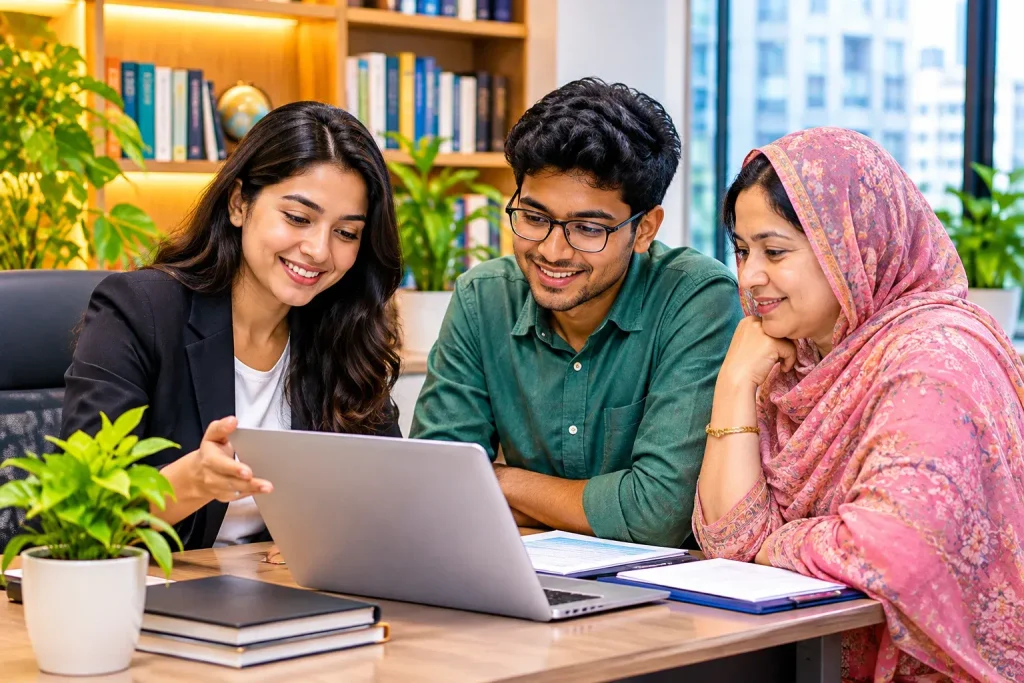
PEC Education Consultants is one of the study abroad consultants in Bangladesh that supports students through every stage of their journey to the USA, from the first counseling session to pre-departure preparation. Here is how.
Based in Dhaka and active since 2016, PEC Education Consultants offers free consultancy and works without hidden charges. Learn more about us or view all our services.
1. University Admission and Application Support
- Profile assessment: A review of your grades, test scores, interests and goals to understand where you stand.
- University and course shortlisting: A balanced list of ambitious, realistic and safer options that match your budget and career plans.
- Guidance on admission requirements: Clear checklists for each school so nothing is missed.
- Application management: Help to apply to US universities accurately, track deadlines and keep documents organized.
- Essay and SOP coaching: Feedback that helps you tell your own story in your own voice.
- Recommendation letter and resume guidance: Advice on who to ask and how to present your achievements.
- Test and English preparation planning: Direction on which exams to take and when.
- Offer comparison: Support to compare admission offers, costs and funding before you decide.
2. Scholarship Application Guidance
- Scholarship research: Identifying university-based, departmental and external options that fit your profile.
- Application strategy: Early planning and strong, tailored materials for US scholarship applications.
- Assistantship guidance: For graduate applicants, advice on approaching departments and professors about teaching and research assistantships.
- Honest expectations: A clear explanation of your chances, without false promises.
3. Study Visa Processing and Guidance
- I-20, SEVIS and DS-160 support: Step-by-step help so your forms are correct and consistent.
- Financial documentation advice: Guidance for you and your sponsor on what to show and how to present it truthfully.
- F-1 visa interview preparation: Mock interviews, feedback and confidence building.
- Visa appointment guidance: Help understanding the booking process and preparing your document file.
- Policy updates: Timely information about new embassy and government announcements that may affect you.
4. Pre-Departure Support
- Housing and budgeting tips
- Travel and packing advice
- Understanding campus life, health insurance and student responsibilities
- Connecting with student communities
A consultant does not replace your effort. They guide you, save you time, help you avoid preventable errors and keep you organized, while the decisions and the truthful information always remain yours.
A Simple Timeline to Study in USA from Bangladesh
| When | What to Do |
|---|---|
| 12 to 18 months before | Research programs, plan finances, begin test preparation |
| 10 to 12 months before | Take English and standardized tests, shortlist universities |
| 8 to 10 months before | Write essays, request recommendations, gather documents |
| 6 to 8 months before | Submit applications and scholarship forms |
| 3 to 5 months before | Receive offers, compare, accept, pay deposit, get I-20 |
| 2 to 3 months before | Pay SEVIS fee, complete DS-160, book and attend the interview |
| 1 month before | Arrange housing, insurance, travel and orientation |
FAQs
Can I study in USA from Bangladesh after HSC?
Yes. Many universities accept HSC or A-Level graduates for bachelor’s programs. Check English score needs, test policies and credential evaluation rules for each school.
What are the main US university admission requirements Bangladesh students need?
Most schools ask for academic transcripts, English test scores, an essay or statement of purpose, recommendation letters, a resume and proof of finances. Some also require SAT, ACT, GRE or GMAT scores.
How do I apply to US universities from Bangladesh?
Research and shortlist schools, prepare your tests and documents, submit applications before the deadlines, apply for scholarships, compare offers and accept one. Then you receive your I-20 and begin the visa process.
How much money do I need for the USA student visa for Bangladeshi students?
You must show funds to cover at least your first year of costs, as stated on your I-20. The exact amount depends on your university’s estimated cost of attendance.
Are there scholarships for Bangladeshi students in USA?
Yes. Options include university merit awards, assistantships, fellowships and departmental funding. Full funding exists but is competitive, so apply to several options.
Is the F-1 visa Bangladesh process difficult?
It can be competitive. Careful preparation, consistent documents, a clear study plan and honest answers improve your chances.
Can I work while studying on an F-1 visa?
On-campus work is allowed within limits, and off-campus work needs specific authorization. Do not rely on work to pay your main expenses.
What happens if my visa is refused?
You may reapply, but only when your situation has meaningfully changed or you can present stronger, accurate information. First understand the reason for the refusal.
Are study abroad consultants in Bangladesh worth it?
They can be, when they are transparent, experienced and honest. A good consultant saves time, reduces errors and gives structured support without promising guaranteed results.
Final Thoughts: Start Early, Stay Honest, Get Expert Guidance
To study in USA from Bangladesh is a big goal, and it deserves a careful plan. Research your options, build a strong profile, prepare your finances, tell your story truthfully, understand the student visa process and stay updated on the latest F-1 rules.
If you want expert help to apply to US universities, meet each school’s admission requirements, find scholarships and prepare for your visa, PEC Education Consultants is ready to support you. Our team is one of the study abroad consultants in Bangladesh that students trust for honest, step-by-step guidance.
Ready to take the first step toward your American degree? Book your free consultation with PEC Education Consultants today at pec-education.com.
Visit PEC Education Consultants
- Address: 767 West Kazipara, Mirpur, Dhaka-1216, Bangladesh
- Phone: +880-1713 167969 or +880-1865 383786
- Office hours: 6 days a week, 10 am to 6 pm
- Website: pec-education.com | Contact page | Blog
Disclaimer: This article is for general information only. Visa rules, fees and scholarship details change often. Please confirm all information with the U.S. Embassy in Dhaka, official U.S. government websites and the universities you apply to. No consultant can guarantee admission, scholarships or visa approval.