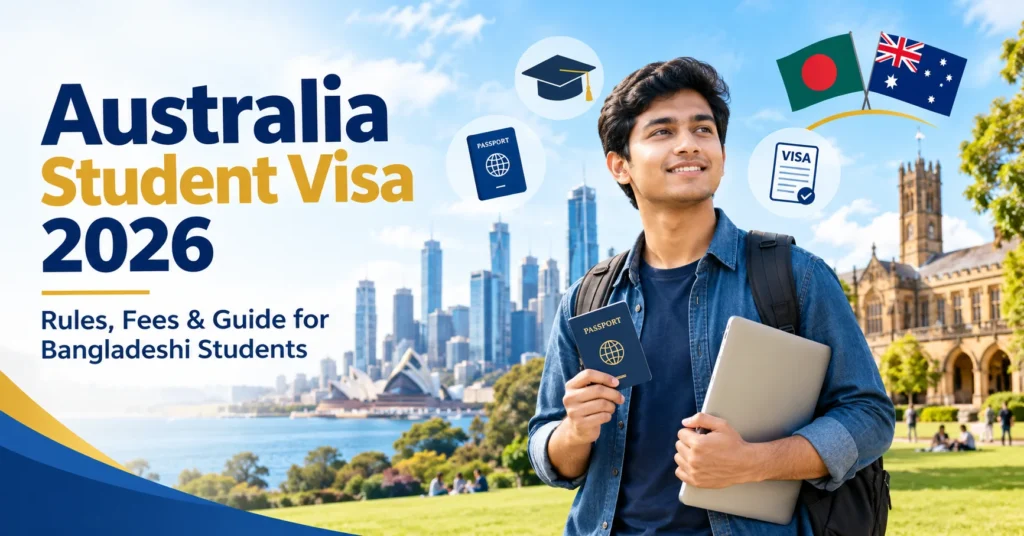
Australia Student Visa 2026: New Rules for Bangladeshi Students, Visa Restrictions, Financial Requirements & Application Guide
Australia is still one of the most popular study destinations for Bangladeshi students. It offers globally ranked universities, a multicultural environment, and a clear route from study to work. But the Australia Student Visa 2026 process is not the same as it was a few years ago. Visa fees are higher, financial proof is stricter, and Bangladesh now sits in the highest evidence category for student visa assessment.
This guide explains what has changed, what you need to prepare, and how to build a strong application. If you plan to study in Australia in 2027, read it before you apply.
What Is the Australia Subclass 500 Student Visa 2026?
The Australia Student Visa 2026 is officially called the Student visa (Subclass 500). It lets international students study full-time at a registered Australian institution. The same visa covers universities, TAFE and vocational colleges, English language courses, and postgraduate research.
To apply, you first need a Confirmation of Enrolment (CoE) from a CRICOS-registered provider. You then lodge your application online through ImmiAccount.
New Rules in the Australia Student Visa 2026 Process
1. Bangladesh Moved to Evidence Level 3
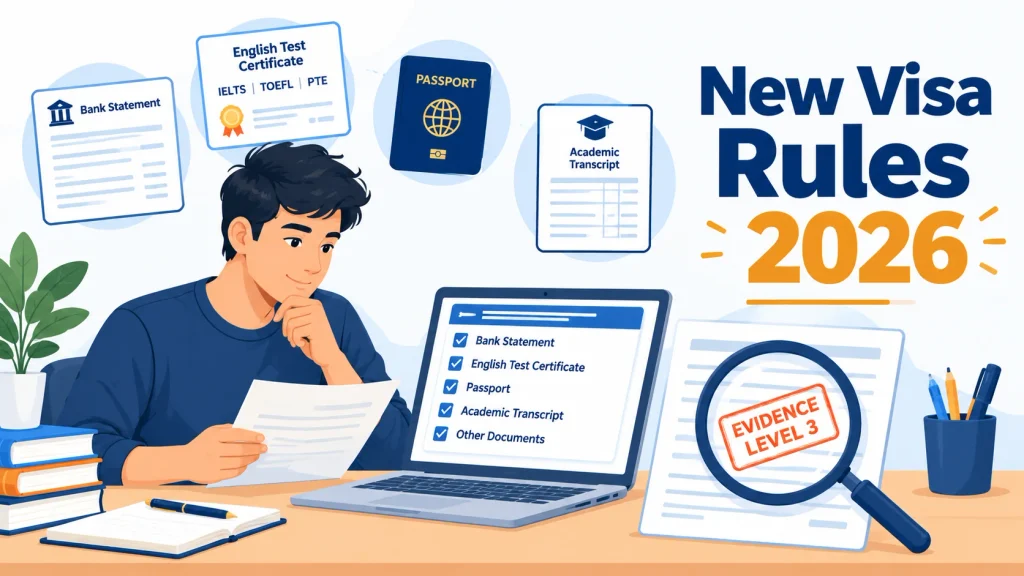
On 8 January 2026, the Department of Home Affairs moved Bangladesh, India, Nepal and Bhutan from Evidence Level 2 to Evidence Level 3. This is the highest tier under the Simplified Student Visa Framework. Home Affairs cited integrity concerns, including fraud-related refusals and visa cancellations.
For you, this means:
- Longer and more detailed document checklists
- Closer checks of financial records, academic papers and English test results
- Possibly longer processing times
Evidence Level 3 does not mean automatic refusal. It means your Australia Student Visa 2026 application must be well documented, genuine and consistent.
2. The Visa Fee Is Now AUD 2,500
From 1 July 2026, the base Subclass 500 application charge rose from AUD 2,000 to AUD 2,500 for most applicants. Reduced charges apply only to some groups, such as students from Pacific countries, Timor-Leste and ASEAN countries. Bangladeshi applicants pay the standard fee.
The fee is generally non-refundable, even if the visa is refused. Check your eligibility carefully before you lodge.
3. The Genuine Student (GS) Requirement
The Genuine Student requirement replaced the old Genuine Temporary Entrant test in March 2024. It is now one of the most important parts of the Australia Student Visa 2026 application. You must show that:
- You genuinely intend to study, and your course fits your background and career plans
- You understand your course, provider and life in Australia
- Your personal and financial circumstances support a temporary stay for study
- Your study will benefit you after you graduate
Generic or copied answers are a common reason for refusal. Write your answers in your own words and support them with evidence.
4. National Planning Level Stays at 295,000 for 2027
The government has confirmed the National Planning Level (NPL) for 2027 will stay at 295,000 new overseas student commencements. This is not a hard cap, and genuine students can still apply. It is a prioritisation system. Applications are processed faster until a provider uses most of its allocation (about 80%), and slower after that.
Choosing a provider with available allocation can therefore affect how quickly you get a decision. TAFE students are exempt from the NPL in 2027.
5. Higher English Standards
Australia has raised its English requirements. For most applicants, the Australia Student Visa 2026 needs an IELTS score of 6.0 overall with no band below 5.5, or an equivalent PTE, TOEFL iBT or similar score. Universities often ask for more, especially for postgraduate and health courses.
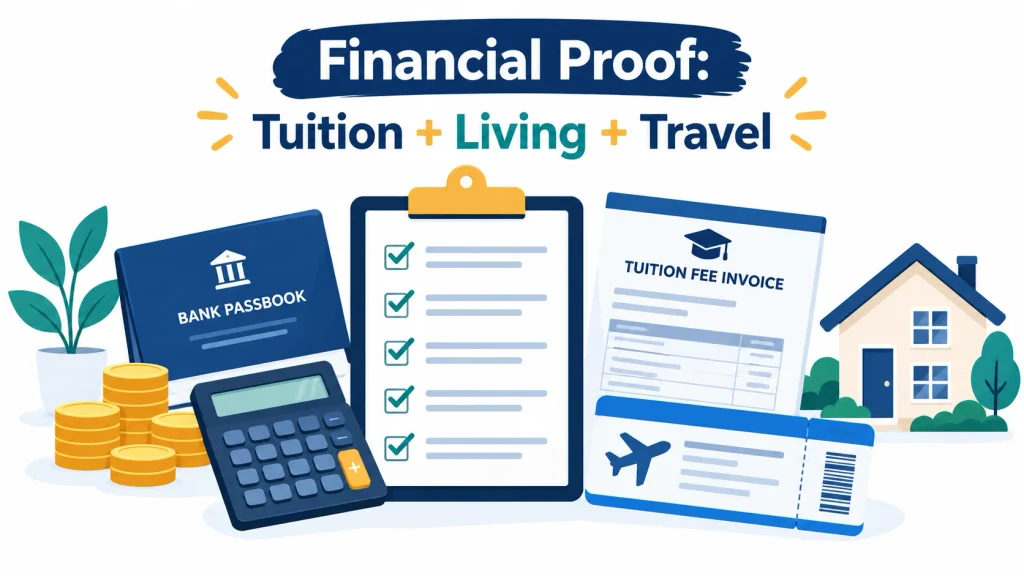
Australia Student Visa Financial Requirements 2026
Weak financial evidence is one of the most common causes of refusal. Home Affairs expects you to show you can cover three things:
- Living costs for 12 months: AUD 29,710 for a single primary student. Accompanying family members add to this.
- First-year tuition fees: the amount stated on your CoE.
- Travel costs: return airfare to Australia.
If children of school age come with you, school fees must also be covered.
Both the amount and the source of the funds matter. For the Australia Student Visa 2026, you should prepare:
- Bank statements and fixed deposit certificates that meet the official requirements
- Clear evidence of your sponsor’s relationship to you
- Documents showing where the money came from, such as business papers, salary slips, tax records or property documents
- Explanations for any large recent deposits
Under Evidence Level 3, expect closer checks of these documents. Avoid last-minute lump-sum deposits, unverifiable sources and third-party arrangements you cannot explain.
Note that AUD 29,710 is a visa calculation, not your real budget. Rent in Sydney and Melbourne is often higher than the visa benchmark assumes, so plan beyond the minimum.
Estimated Costs for Bangladeshi Students
| Item | Approximate Cost |
|---|---|
| Visa application charge | AUD 2,500 |
| Living costs (visa benchmark) | AUD 29,710 per year |
| Tuition | Varies by course and university |
| OSHC (health cover) | Varies by provider and course length |
| Flights | Depends on season and route |
Always confirm the latest figures on the Home Affairs and Study Australia websites before you lodge.
Visa Restrictions and Conditions to Know
Once your Australia Student Visa 2026 is granted, you must follow its conditions:
- Work limits: up to 48 hours per fortnight while your course is in session, and unlimited hours during official breaks. Different rules apply to some research students.
- Attendance and progress: you must attend classes and make satisfactory academic progress.
- Health cover: you must keep valid Overseas Student Health Cover (OSHC) for the whole stay.
- Provider changes: changing course or provider can affect your visa, so get advice first.
- Temporary Graduate visa (Subclass 485): the application charge rose to AUD 5,750 from 1 July 2026, and English requirements are higher. Do not plan your whole future around post-study work rights without checking the current rules.
Step-by-Step Application Guide
Step 1: Choose the right course and university. Match your academic background, budget and career goals. A logical study path supports your Genuine Student case.
Step 2: Apply for admission. Submit transcripts, certificates, English scores, a CV and a statement of purpose to your chosen provider.
Step 3: Accept your offer and pay the deposit. Then receive your CoE.
Step 4: Arrange OSHC. Many universities can help you buy it.
Step 5: Prepare financial and GS documents. Build your funds evidence and write your Genuine Student answers early.
Step 6: Lodge online. Create an ImmiAccount, complete the form, upload documents and pay the fee.
Step 7: Complete health and biometrics if requested. Respond to any request for further information quickly.
Step 8: Wait for the decision. Do not book non-refundable flights before the visa is granted.
Intake tip: Most Bangladeshi students aim for February/March or July intakes. Start preparing 6 to 8 months early, especially under Evidence Level 3.
Common Reasons for Refusal
- Weak or inconsistent financial documents
- Generic or copied GS answers
- Course choice that does not match academic or work history
- Unexplained gaps in study or employment
- English test score below the required level
- Unclear source of funds
- Missing or inaccurate information
Every one of these problems can be reduced with careful preparation.
Scholarships for Bangladeshi Students
You can cover part of your costs through scholarships. Options include:
- Australia Awards: government-funded scholarships offered to eligible applicants from Bangladesh.
- University scholarships and fee reductions: many Australian universities offer merit-based awards for international students.
- Research scholarships: funded places for PhD and research master’s students.
Deadlines are often early, and some awards need a strong academic record, work experience or a research proposal. Scholarship applications also need careful, honest documentation.
How PEC Education Consultants Can Help
Handling the Australia Student Visa 2026 process alone can be stressful, especially under Evidence Level 3. PEC Education Consultants supports Bangladeshi students at each stage:
University admission and application guidance
- Profile assessment and course and university selection based on your goals, budget and academic background
- Help preparing and submitting applications, including your statement of purpose and documents
- Guidance on English test requirements and intake planning
Scholarship application support
- Help finding scholarships you may qualify for
- Support preparing application documents, essays and supporting evidence
Study visa processing and guidance
- Document checklist preparation based on your evidence level
- Review of financial documents and source-of-funds evidence
- Genuine Student statement guidance, so your answers are authentic and consistent
- Application checking before lodgement and support after submission
Pre-departure support
- Guidance on OSHC, accommodation, travel and settling in
No consultant can guarantee a visa, because the decision rests with the Department of Home Affairs. What PEC can do is help you apply honestly, accurately and with complete documents.
Ready to start? Contact PEC Education Consultants to book a consultation for your Australia Student Visa 2026 application.
Frequently Asked Questions
1. What is the Australia Student Visa 2026 fee?
The standard Subclass 500 application charge is AUD 2,500 from 1 July 2026.
2. How much money do I need to show?
You need to show funds for 12 months of living costs (AUD 29,710 for a single student), first-year tuition and travel. Family members add to the total.
3. Is Bangladesh a high-risk country for the Australia Student Visa 2026?
Bangladesh was moved to Evidence Level 3, the highest tier, on 8 January 2026. This means more documentation and closer checks, but genuine, well-prepared applicants can still be granted visas.
4. Can I work during my studies?
Yes. The limit is 48 hours per fortnight during term and unlimited hours during official breaks, with exceptions for some research students.
5. What English score do I need?
For most applicants it is IELTS 6.0 overall with no band below 5.5, or an equivalent test. Your university may ask for more.
6. Do I need a consultant to apply?
No, you can apply yourself. But expert guidance can help you avoid mistakes in documents and GS answers.
7. Can I apply for scholarships?
Yes. Options include Australia Awards and university scholarships, and early planning improves your chances.
Final Thoughts
The Australia Student Visa 2026 is still within reach for genuine Bangladeshi students, but you need more preparation than before. Choose the right course, build clean financial evidence, write honest Genuine Student answers, and start early. With good planning and the right support, your Australian study plans can move forward with confidence.
Disclaimer: Visa rules, fees and requirements change often. Confirm all details with the Australian Department of Home Affairs and Study Australia before applying.